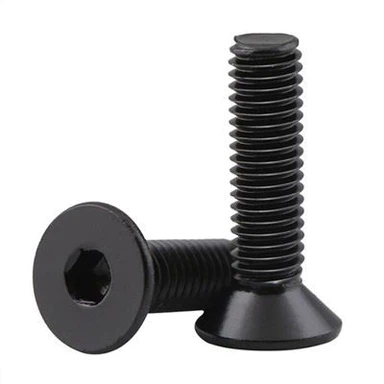
The Effective Methods Of Bolt Tightening
Feb 23, 2023
At present, almost allbolt tightening used in industry need to be controlled, which is called torque control.
Torque refers to industrial fastening with predetermined torque or predetermined torque and angle to ensure sufficient clamping force and reliability of threaded connection.

Bolt tightening is a very complex physical process. The most important factors affecting bolt tightening are torque, preload, friction and material hardness. Only when the above factors are fully considered can safe bolt fastening be ensured.
The torque wrench can control the force applied to a thread tightening, which cannot be less or more. In most cases, the traditional torque wrench can already provide the effect of tightening bolts with sufficient accuracy. However, when a more accurate and safe thread tightening is required, the manual torque wrench is not suitable, because the torque applied often does not meet the requirements of preload and the corresponding preset value, because it is not accurate.
The source of inaccurate value is often caused by the bite between the tightening threads and the friction between the bolt head and the plane of the fastening object. The so-called pre-tightening force or clamping force is a contact pressure generated by the contact of the workpiece in the screw connection, which is universal. The pressure increases the friction between the workpieces, and the friction makes the torque not fully pre-tightened, so only about 10% of the torque we apply can be converted into the tightening force of the bolt.
In order to achieve higher accuracy, even in the manual tightening of bolts, the angle-controlled tightening technology is often used, especially in the current rapidly developing automobile manufacturing industry. Through this technology, each bolt can achieve its maximum tightening effect. Rotation angle refers to the angle value between the original tightening of the bolt and the final reaching of the specified torque value.
Generally speaking, the degree of rotation will vary according to the material of fasteners and parts to be fastened. For example, for materials with high hardness, such as carbon steel, the number of corners required for fastening will be relatively small; For materials with low hardness, such as wood, the number of corners required for fastening will be relatively large, and the force loss caused by friction will also be large, and the fastening force that can be achieved will be relatively small.

In the process of controlling the angle of thread tightening, the torque control is used to tighten the bolt to a fixed torque value at the beginning. After reaching this torque, the subsequent tightening process is carried out under the dual control of torque and angle until the preset tightening torque and rotation angle are reached. The correct use of the angle control system can prevent the bolt from entering the plastic zone of the material, prevent exceeding the acceptance yield point of the bolt, and cause potential safety hazards. At the same time, the corner control can also significantly reduce the loss of locking force and ensure that sufficient preload is achieved.
In the process of bolt tightening, the torque used and the degree of rotation angle are different, so the bolts that have been tightened by rotation angle control cannot be used again.
There are two main types of bolt tightening methods, namely elastic tightening and plastic tightening. Elastic tightening generally refers to torque tightening method, while plastic tightening mainly includes corner tightening method and yield point tightening method.
1. Torque tightening method
The principle of torque tightening method is that there is a certain relationship between torque and axial preload. The pre-tightening force of the connected parts is controlled by setting the tightening tool to a certain torque value. On the premise of stable process, part quality and other factors, this tightening method is simple and intuitive to operate, and is widely used at present. According to experience, when tightening bolts, 50% of the torque is consumed on the friction of the bolt end face, 40% on the friction of the thread, and only 10% of the torque is used to generate the preload.
Because the external unstable conditions have a lot of influence on the torque tightening method, the torque method that indirectly controls the preload by controlling the tightening torque will lead to low control accuracy of the axial preload. In addition, there are very few bolt connections, the torque has reached the specified value, and the bolt head has not yet fully fitted with the connected parts or the gap is sometimes very small, which is not easy to find by visual inspection. At this time, the torque value is qualified, but the preload is very small, or even no, so in this case, if only to guarantee the torque is qualified, then ensuring the assembly and tightening quality becomes a hollow word.
2. Angle tightening method
In view of the shortcomings of the torque tightening method, the United States began to study the relationship between bolt elongation and axial force in the late 1940s. The rotation angle during bolt tightening is roughly proportional to the sum of the bolt elongation and the looseness of the tightened parts, so the method of reaching the predetermined tightening force according to the specified rotation angle can be adopted. First, tighten the bolt to the initial torque, that is, stretch the bolt to the yield point, and then rotate a certain angle to stretch the bolt to the plastic area.
The essence of the rotation angle tightening method is to control the elongation of the bolt. In the elastic range, the axial preload is proportional to the elongation. The control of the elongation is to control the axial force. After the plastic deformation of the bolt begins, although the two are no longer proportional, the mechanical properties of the bolt under tension show that the axial preload can be stabilized near the yield load as long as it is kept within a certain range.
Therefore, the final torque of two bolts with different friction coefficients after tightening with the same tightening method is very different, but the pre-tightening force is not different due to the same bolt strength and size. Compared with the torque tightening method, it not only completes the tightening control with high accuracy, but also fully improves the utilization rate of materials.
3. Yield point tightening method
The theoretical goal of the yield point tightening method is to tighten the bolt just beyond the yield limit point. When using the yield point tightening, first tighten the bolt to a specified starting torque. From this point on, the equipment monitors the change of the slope value of the tightening curve. If the slope decreases to more than the set value, it is considered that the bolt has been stretched to the yield point, and the tool stops running. The biggest advantage of the yield point tightening method is that all bolts with different friction coefficients are tightened to their yield point, which maximizes the strength potential of threaded parts. However, it is sensitive to interference factors, and has high requirements for the performance and structural design of bolts, which is difficult to control. Therefore, tightening tools are very expensive.